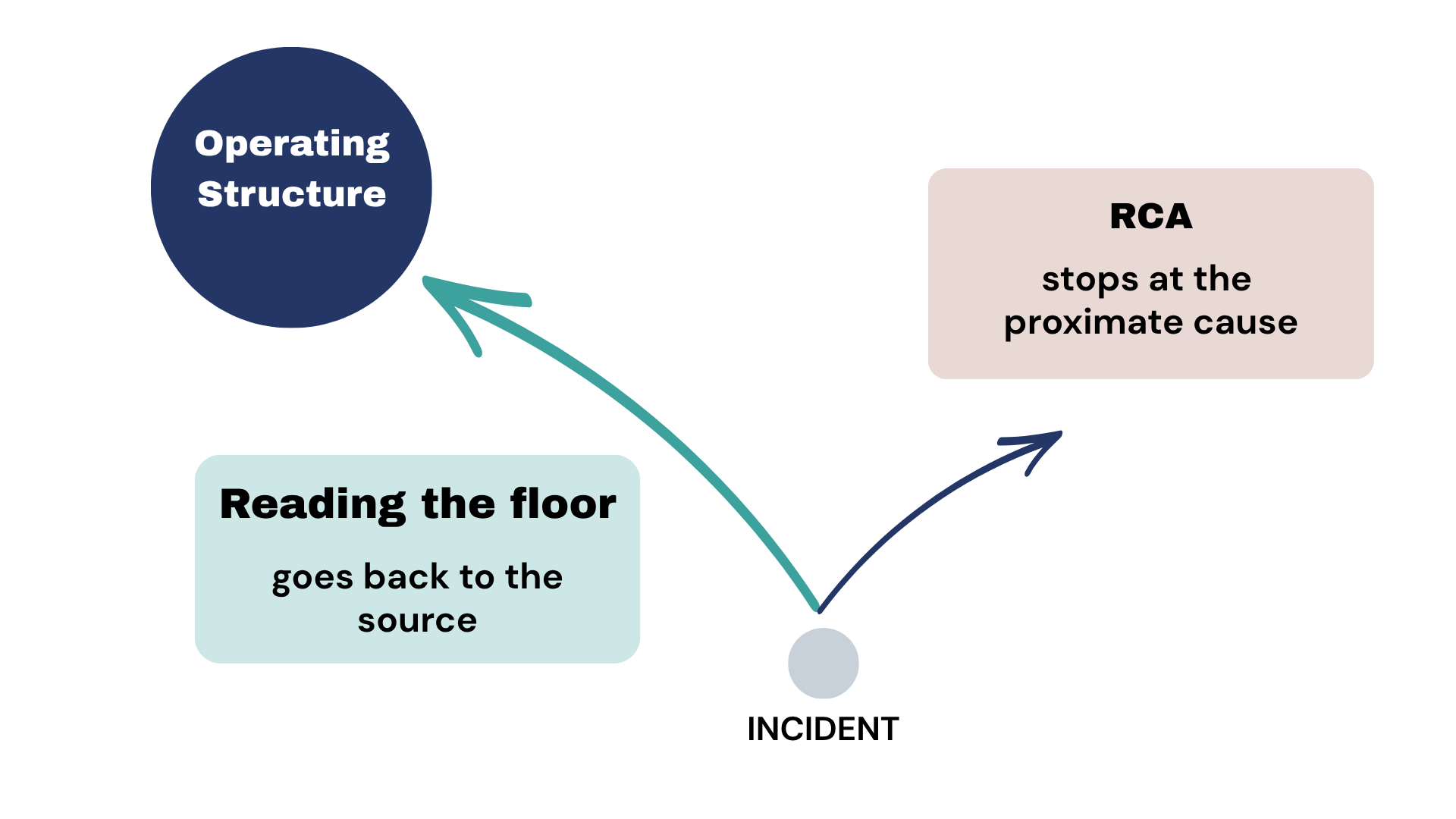
This workshop session is about one thing: learning to read the floor. Reading the floor is the first move in a process to make improvement stick. In Workshop 1: Decision Clarity on the Floor, you'll learn to see who actually has standing to make a call on your floor, what needs to take place before they act on it, and what happens when that call turns out wrong. Unlike RCA, which traces one incident back to its immediate cause, this skill set traces the same incident back to the source.
Most fixes focus on a person's attitude, a training gap, or a tool nobody's using. The real source of the problem is that nobody was ever told, clearly and consistently, whose call it was to begin with. Or worse, it keeps changing. Get the read right and you've already done the hardest part.
“I didn't want it to look like I couldn't handle it.”— Phil, second-shift lead
The session draws on real-life examples of floor-level decision-making, and how ordinary situations like a repeat problem nobody's claimed reveal just how much the floor relies on clear decisions.

The situation above isn't unusual. It's what happens on most floors, most of the time. It isn't clear whose call something actually is. That lack of clarity causes problems: work stoppages without clear justification, unnecessary escalations, misses, and rework. Fixing it reduces or eliminates these problems. Here's what that gap actually costs, and what closing it buys.
Learn to read what's actually happening on your floor, not just what's supposed to happen. You'll leave with one tool to guide the conversation with the people closest to the work, this week.
Signing up gives you everything from the session, not just the hour itself. You'll have something to keep, revisit, and actually use on your own floor.
A real case, a live discussion, and one reading-the-floor exercise you'll actually do before the session ends.
On-demand and free, whether you attend live or not. Watch it again or share it with your team.
A one-page tool that walks you through a real conversation on your own floor, after the session.
The full case, a written reflection, and a worksheet for naming a decision gap at your own plant.
Managing large-scale change early in my career, I saw well-resourced teams repeatedly stall at the same place: getting people to accept change they didn't have a say in building. The default response was always more communication, persuasion, and training. I took a different approach. I found out what people actually wanted. What I found: people almost always shared the same core goals. The only difference was whether they believed their perspectives really mattered.
Once people see they have a real say, the so-called resistance largely disappears. That's because it was never actually resistance in the first place. For years, I've applied this same logic to manufacturing, building the reinforcement habits and decision clarity that make new behaviors actually stick. It works whether or not you're running a formal continuous improvement system.
12:00 PM on Wednesday, October 7, 2026 · 60 minutes · Free · Live online. Can't make it live? Register anyway — the recording goes to everyone.