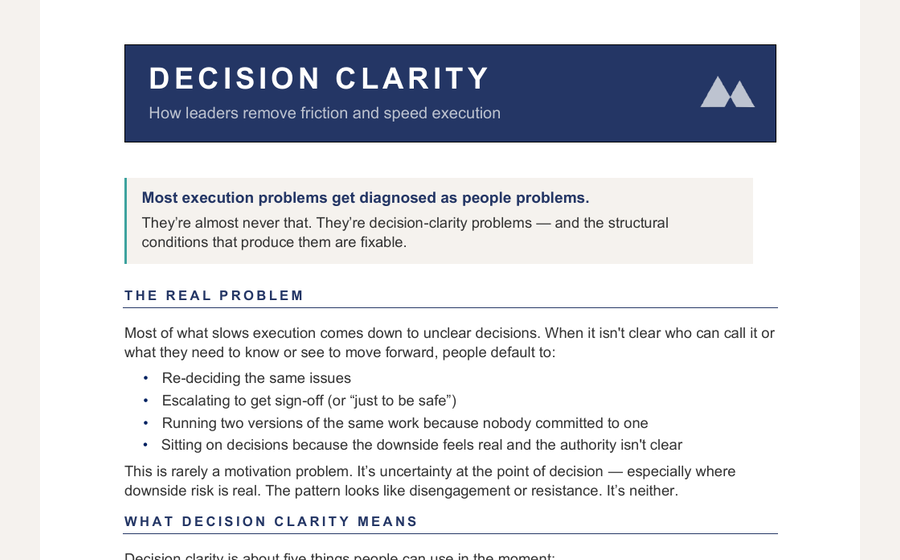
Start with the Brief
Decision Clarity Brief™
This lays out the five elements that make decisions hold: decision owner, evidence standard, stop/escalate triggers, handoff acceptance, and leader reinforcement.
View the BriefUse these tools when work is slowing down and it is not clear why: decisions get re-made, standards drift, ownership feels fuzzy, or people are not sure what should happen next.
Join our free 60-minute live session on October 7, 2026. Learn to read the floor, and see what's actually holding your operation back.
View Workshop Details →It usually starts with an operating gap. People are not fully clear on who owns the call, what is enough to proceed, when to pause or escalate, what “done” means at the handoff, or what leaders will reinforce afterward.
That uncertainty shows up as hesitation, escalation, rework, workarounds, or the same decision being revisited again and again.
The brief explains the model. The card helps you apply it to one real decision point with the people who live the work.
This lays out the five elements that make decisions hold: decision owner, evidence standard, stop/escalate triggers, handoff acceptance, and leader reinforcement.
View the Brief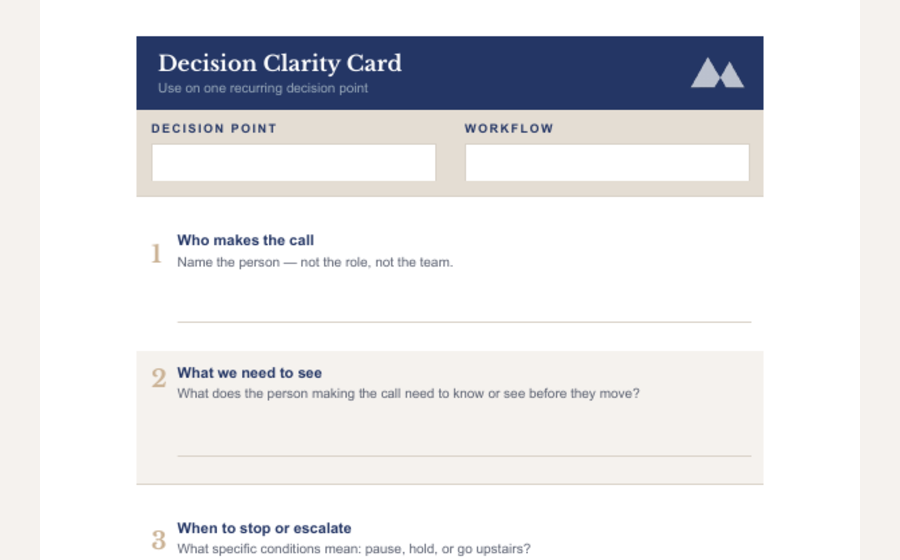
A working tool for building understanding around who owns the call, what's enough to proceed, when to pause, and what leaders back up afterward.
View the CardStart with one recurring decision point where stalls, rework, escalation, or workarounds are visible.
Most teams try to solve this by adding more oversight. That usually slows things down without fixing the operating gap underneath.
If the same friction keeps showing up, a focused conversation can help clarify the operating structure behind it.